The stable operation of industrial fluid pipeline systems relies on high-quality pressure regulating accessories for protection. As a core pressure regulating component, the pressure reducing regulator can accurately lower the high pressure of the imported medium to the required low pressure for the working condition, effectively ensuring the safe operation of the entire system.
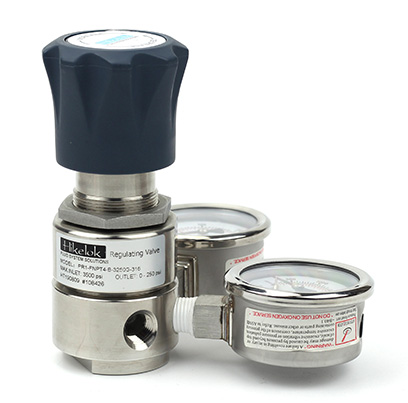
The Hikelok PR1 series precision pressure reducing regulator comprehensively covers laboratory gas circuits, analyzer calibration gas supply, special industrial gas cylinder pressure regulation, chromatographic fuel delivery and other scenarios. With precise pressure control technology, it provides safe and stable professional pressure regulation guarantee for industry and scientific research.
01 Product Features
*compact design
*High sensitivity adjustment
*Designed to minimize pollution and precisely regulate any corrosive, non corrosive, or toxic gases
*The sealing of metal to metal diaphragm to regulator body ensures minimal external leakage
*The corrugated diaphragm provides excellent precision and a long service life
*Panel installation available
02 Product Parameters
|
Parameters |
Technical Indicators |
|
Maximum Inlet Pressure |
3500 psig(≈ 241 bar) |
|
Multiple Optional Outlet Pressure Ranges |
0-25 psig (0-1.7 bar), 0-50 psig (0-3.4 bar), 0-100 psig (0-6.9 bar),0-250 psig (0-17.2 bar), 0-500 psig (0-34.5 bar) |
|
Design Test Pressure |
150% of maximum working pressure with ample safety margin
|
|
Leakage Performance |
Zero internal bubble leakage; external helium leak rat ≤ 2×10⁻⁸ atm・cc/sec,suitable for high-purity and toxic media environments |
|
Wide Temperature Adaptability |
Three regulator seat material options for different temperature ranges• PCTFE:-40℃ ~ 80℃ • PEEK:-40℃ ~ 200℃ • PI:-40℃ ~ 260℃ |
|
Flow Coefficien(Cv) |
0.06 |
03 Core Structure
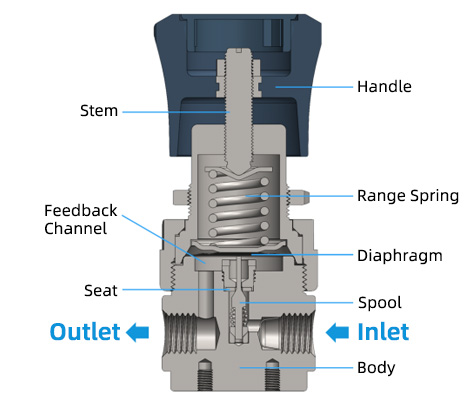
Adjustment components: handle, range spring (set outlet pressure)
Sensing component: diaphragm (core pressure sensing element, separating upper and lower chambers)
Execution components: stem, spool, seat (controlling fluid on/off and throttling)
Body: including inlet, outlet, and feedback channel (directing outlet pressure to the lower chamber of the diaphragm)
04 Working principle
1. Pressure setting (initial equilibrium)
Rotate the handle, compress the range spring, and generate a downward set force.
The spring force pushes the diaphragm, stem, and spool downwards, opening the regulator port.
The high-pressure medium flows in from the inlet, undergoes throttling and pressure reduction, and then flows towards the outlet.
The outlet pressure acts on the underside of the diaphragm, generating an upward feedback force.
When the spring force (downward) equals the outlet pressure feedback force (upward), the spool remains stationary and the outlet pressure stabilizes at the set value.
2. Dynamic adjustment process
Scenario A: Decreased outlet pressure (increased downstream usage)
The feedback force on the lower side of the diaphragm decreases → spring force>feedback force.
The diaphragm drives the spool to move downwards → the regulator opening increases → the medium flow rate increases → the outlet pressure rises to the set value.
Scenario B: Increased outlet pressure (decreased downstream usage)
The feedback force on the lower side of the diaphragm increases → feedback force>spring force.
The diaphragm drives the spool to move upward → the regulator opening decreases → the medium flow rate decreases → the outlet pressure drops to the set value.
05 Flow characteristic curve
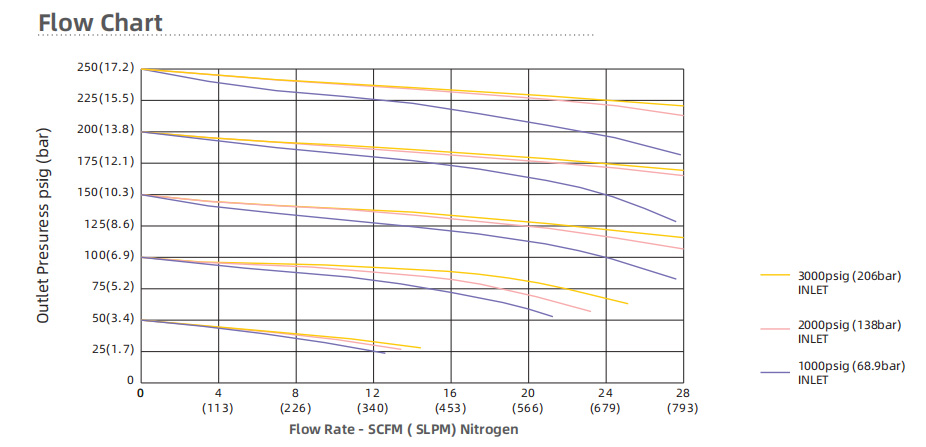
Under high pressure, the stabilizing performance curve of the pressure reducing regulator:
Under medium and low pressure, the stabilizing performance curve of the pressure reducing regulator:
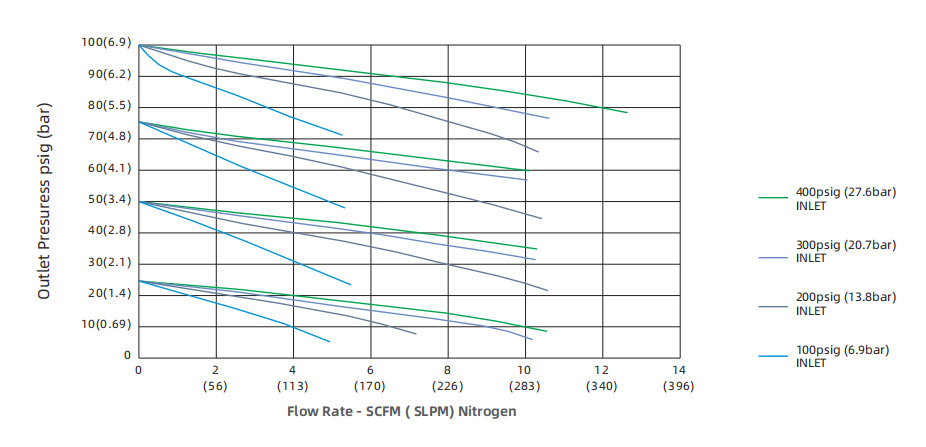
Curve analysis: The horizontal axis represents nitrogen flow rate, and the vertical axis represents outlet pressure. The smoother the curve, the better the pressure stabilization performance under this operating condition; The higher the inlet pressure, the wider the pressure stabilizing range.
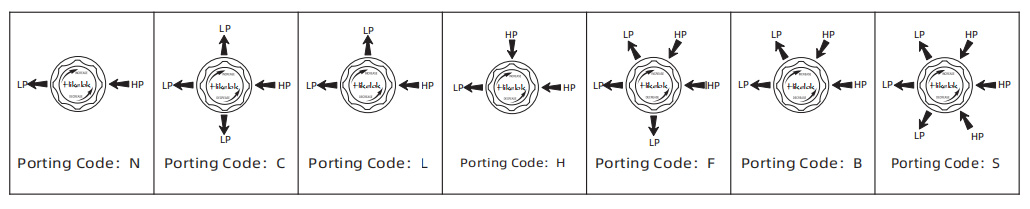
06 Path Options (LP=Low Pressure; HP=High Pressure)
07 Precautions
Selection and matching: Before use, it is necessary to confirm the material, connection, and range of the pressure reducing regulator to ensure complete matching with the working conditions, and misuse is strictly prohibited.
Leakage detection: After ventilation, a leak test must be conducted to confirm that there is no leakage before it can be put into normal use.
Oil prohibition for oxidizing gases: Under oxidizing gas conditions, oil must be strictly prohibited in pressure reducing regulators and pipelines to eliminate safety hazards.
Pressure relief operation: After use, the pressure must be completely relieved, and the regulator should not be in a pressure holding state for a long time.
Toxic gas emissions: Toxic gas residual pressure must not be directly discharged and must be connected to a dedicated discharge pipe or treated in a fume hood.
For more ordering details, please refer to the selection catalogs on Hikelok's official website. If you have any selection questions, please contact Hikelok's 24-hour online professional sales personnel.
Post time: Jul-10-2026